


The natural world is full of wonders, but some creatures push the boundaries of what science can fully explain. From extraordinary senses to bizarre survival skills, these animals display abilities that continue to baffle researchers, leaving both scientists and curious minds in awe. Here are five animals with abilities that remain mysterious even in 2025.
1. The Electric Eel: Nature’s Living Battery
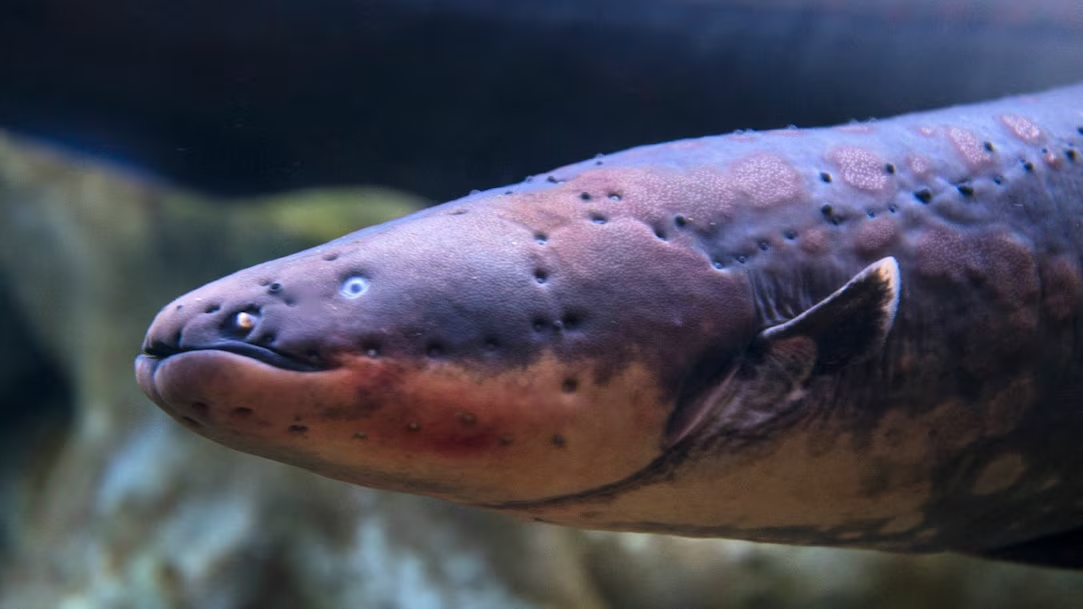
Electric eels (Electrophorus electricus) can generate bursts of electricity of up to 600 volts—enough to stun prey or even threaten humans. Scientists have long understood that these fish have specialized electric organs made of electrocytes, which function like biological batteries. But recent studies reveal a layer of complexity that is still puzzling.
In 2024, researchers discovered that electric eels can coordinate electrical discharges in rapid, seemingly purposeful sequences to manipulate prey behavior in ways previously thought impossible. For instance, eels appear to send pulses that confuse the nervous system of multiple prey at once, creating a synchronized “paralysis zone.” How they achieve this precise control over electrical fields across multiple targets is still not fully understood. Some scientists suspect subtle bioelectrical communication mechanisms that have yet to be identified.
2. The Immortal Jellyfish: Defying Age

Turritopsis dohrnii, commonly called the “immortal jellyfish,” has the remarkable ability to revert its adult cells back to a juvenile state, essentially restarting its life cycle. While it’s not truly immortal in the sense of being invincible, this process theoretically allows the jellyfish to bypass natural death indefinitely.
The mystery lies in the underlying cellular mechanics. Researchers have found that the jellyfish uses a process similar to transdifferentiation, where one cell type transforms into another. Yet, the triggers that initiate this process, especially under stress or injury, remain elusive. Understanding this phenomenon could have profound implications for regenerative medicine and aging research—but for now, it remains a captivating enigma of the oceans.
3. Pigeons: The World’s Unexpected Navigators

Homing pigeons have been used by humans for centuries to carry messages across vast distances, yet scientists are still unraveling how they navigate with such precision. Studies suggest they use a combination of visual landmarks, the sun, Earth’s magnetic field, and even olfactory cues.
However, some experiments have confounded researchers. Pigeons can apparently detect magnetic anomalies and shifts in the Earth’s field, adjusting their route in ways that no other animal seems capable of. Even more astonishing, some pigeons appear to recalibrate their sense of direction after being displaced hundreds of miles from their home lofts—without prior exposure to the terrain. The exact biological “compass” mechanism remains a subject of debate, blending physics, biology, and a touch of mystery.
4. The Lyrebird: Nature’s Perfect Mimic

Australia’s lyrebird is a master of imitation, capable of replicating not just other bird calls but chainsaws, camera shutters, car alarms, and human voices with uncanny accuracy. While scientists understand the mechanics of its syrinx (vocal organ) and impressive neural control, the lyrebird’s cognitive abilities are still astonishing.
The real mystery is why and how lyrebirds learn to mimic sounds they have likely never heard in the wild and reproduce them with perfect timing and tone. Some researchers theorize this skill plays a role in mating rituals and social hierarchy, yet the precision and breadth of mimicry suggest a level of auditory intelligence that pushes the boundaries of current animal cognition studies.
5. The Mantis Shrimp: Seeing a World Humans Can’t
The mantis shrimp, a small marine predator, possesses one of the most sophisticated visual systems known to science. While humans have three types of photoreceptor cells for color vision, mantis shrimp can have up to 16 types, allowing them to perceive polarized light and ultraviolet wavelengths.
This ability not only helps them detect prey and predators in the complex reef environment but also appears to enable forms of communication invisible to other animals. Scientists still don’t fully understand how the shrimp’s brain processes such an overwhelming amount of visual information or how it translates this data into precise hunting and social behavior. The mantis shrimp’s eyes remain one of the most baffling mysteries in the natural world.
Why These Mysteries Matter
These extraordinary abilities remind us that the natural world is far more complex and nuanced than we often realize. Studying these animals isn’t just about curiosity—there are potential applications in technology, medicine, and robotics. For example, the electric eel inspires bioelectric devices, the mantis shrimp informs advanced camera sensors, and the immortal jellyfish fuels anti-aging research.
Yet despite centuries of study, nature continues to challenge our understanding. These five creatures are a glimpse into the unknown, a reminder that even in 2025, science has limits, and some secrets may remain just out of reach.
Takeaway: The electric eel, immortal jellyfish, homing pigeon, lyrebird, and mantis shrimp all show that evolution has equipped certain species with abilities that remain partially or wholly unexplained. Their mysterious powers are a testament to the complexity of life on Earth—and a call to keep exploring, observing, and questioning the natural world.